研究成果藝廊
How does a chaotic star-forming cloud become a planet-forming disk — Theoretical and Observational Evidences of ENDTRANZ
圖片來源: Indrani Das/ASIAA
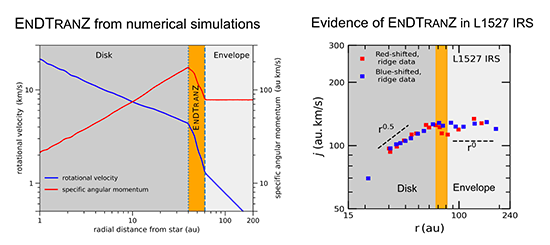
Left figure: The radial variation of rotational velocity and specific angular momentum with distance from the star in astronomical units (or au) on the left- and right-hand axis, respectively, as obtained from the numerical collapse simulations. The orange-colored region represents the ENDTRANZ of a young stellar system.
Right figure: The radial variation of the specific angular momentum in class 0/I protostar L1527 IRS is shown based on the blue- and red-shifted velocity components. A jump in the observed radial profile of specific angular momentum at the region highlighted in orange color is the evidence of ENDTRANZ.
Protoplanetary disks form around young stars when dense molecular cloud cores collapse under their own gravity. An outer shroud of gas and dust, known as the envelope, surrounds and feeds both the young star and the forming disk.
In this work, we investigate the envelope–disk transition zone (ENDTRANZ), which is the region where collapsing molecular cloud material transitions into a rotationally supported protoplanetary disk. Using global MHD disk simulations alongside ALMA Large Program eDisk observations of L1527 IRS, we show that this transition is not abrupt, but instead occurs through a radially extended zone marked by a “jump” in specific angular momentum. This jump reflects a shift from infall-dominated motion to Keplerian rotation, and serves as a kinematical tracer of angular momentum redistribution during star–disk formation. This work contributes to a broader effort to understand how collapsing star-forming clouds ultimately become planetary systems.
Please refer to ASIAA's science highlight for a full read on this research.
This research was published in an article titled “Modeling the Break in the Specific Angular Momentum within the Envelope-Disk Transition Zone” by Das, I. et al. in the Astrophysical Journal, with a DOI: 10.3847/1538-4357/ae4725.